Landmark Gene Patenting Case Heading Back to the Supreme Court

The protracted battle over the patenting of the BRCA breast cancer mutations witnessed another volley in late November the Supreme Court granted certiorari (in part) to take up the case against Myriad Genetics, the Utah-based biotechnology firm who holds the patent. The case stands to have a major impact on the emerging field of personalized medicine, where physicians armed with complete genetic data on patients can tailor treatment plans to match an individual’s specific physiology. The patent system has long upheld the idea that “laws of nature” cannot be patented, however our growing technical and scientific abilities have increasingly blurred the critical distinction between patentable innovation and unpatentable discovery. Laying Claim to a Genetic Variant

At its heart, this case hinges on the patent claims of Myriad Genetics, which include a claim to the BRCA1 and BRCA2 mutations, two genetic variants which are known to significantly increase a woman’s probability of developing breast and ovarian cancer. The application of this patent by Myriad Genetics has created a monopoly on screening for this variant, with the patent-holder’s lab being the only one in the nation performing all commercial tests for the BRCA mutations. Though this claim has been challenged, the US Court of Appeals for the Federal Circuit affirmed the validity of the patent in July of 2011, holding that the complimentary DNA developed to interact with this variation was an invention, and sufficiently distinct from the underlying natural processes to be patentable. Ass'n for Molecular Pathology v. U.S. Patent & Trademark Office, 653 F.3d 1329 (Fed. Cir. 2011). Following the denial of two requests for a rehearing the case seemed settled until  the  of 2012.

A Ray of Hope for Opponents of Gene Patenting

The Supreme Court’s recent decision in Mayo Collaborative Services v. Prometheus Laboratories, Inc. appeared to be the signal that detractors of gene patenting were looking for. That case, decided in March of 2012, struck down a patent on a technique for calibrating dosage of an autoimmune medication, holding that the patent did not diverge sufficiently from the underlying law of nature, and as such was not patentable. On it’s face, this case bears a striking similarity to the case against Myriad Genetics. In both instances, observations of underlying facts of biology serve as the lynch pin for the claimed patient.

With this in mind, the ACLU, who is trying the case on behalf of a host of plaintiffs, filed a petition of certiorari, asking the court to take up the Myriad Genetics case in light of their findings in Mayo Collaborative Services. The court apparently agreed, as they vacated the Federal Circuit Court of Appeals decision and asked that court to revisit the case in light of the Mayo decision. Ass'n for Molecular Pathology v. Myriad Genetics, Inc., 132 S. Ct. 1794, 182 L. Ed. 2d 613 (2012).  Given the court’s decision to remand the case, it seemed certain that Myriad’s patent would be invalidated. Nevertheless, the Court of Appeals essentially reaffirmed their previous decision, claiming the case was distinguishable from the Mayo Collaborative case, while both tests involved the observation of natural reactions, the Myriad technique uses man-made cells in the testing process, rather than observing purely natural metabolism. This ruling fundamentally upholds the right to patent genes, and reinforces the exclusive right of Myriad to test for the BRCA variation.

Following the Federal Circuit Court of Appeals Court’s ruling, the ACLU again petitioned the Supreme Court for certiorari. Representatives of the ACLU stated that they believe the appellate court failed to “fully consider or correctly apply” the Mayo Collaborative case. The court granted certiorari in part to answer the principle question of the appeal: Are human genes patentable?  Ass'n for Molecular Pathology v. Myriad Genetics, Inc, 133 S. Ct. 694 (U.S. 2012).

Assessing the Potential Impact of Myriad Genetics

The potential impact of the Myriad Genetics case is difficult to understate. Genes are the fundamental blueprints for human physiology, and we are only beginning to unravel the vast complexity of their application. By allowing private organizations to patent genes or gene variants, we run a serious risk of inhibiting discovery in this critical field by instilling a fear in scientist of facing patent infringement litigation as a result of their work.

On a more practical level, the diagnostic monopoly being enforced by the court allows Myriad Genetics to charge over $3,000 for the test. In contrast, many predict that scientists will be able to sequence an individual’s entire genome for a mere $1,000 in just a few years. The ability to access this incredibly valuable diagnostic information could be hindered if gene patents continue to be enforced. For example, if a patient’s whole genome is sequenced, it may be the case that her physician can’t share the results of the screening in terms of any BRCA outcomes without paying Myriad Genetics for the right to do so. Multiply this result by the thousands of genes that have been patented to this point, and the development of inexpensive full-genome screening could be undermined entirely, depriving the medical field of a critical diagnostic tool.

To date, the damage incurred by enforcing Myriad’s BRCA patent has been relatively minimal. Nevertheless, as the industry continues to grow and more and more genes are patented, this question is likely to arise more and more, with potentially greater consequences than we have seen in this case. Now that the Supreme Court has chosen to hear the case against Myriad Genetics, we may see the first definitive ruling on the patentability of human genes as early as this summer. We will continue to track this case on the blog through the Supreme Court arguments this spring and the ruling this summer. To track these and other interesting developments in the IP world, subscribe to the blog using the link to the right.
Fifty Shades Too Grey? written by Jonathan Feder

With millions in book sales and a movie in the works it is a question that is all too obvious to ignore—does Fifty Shades of Grey infringe on the copyright of Stephenie Meyer’s Twilight series from which it was adapted? (Find the text of Ewan Morrison's article in which he explores the same question here) Federal law, specifically 17 U.S.C.A. § 106, gives the owner of a copyright the exclusive right to prepare or authorize “derivative works based upon the copyrighted work.” But the fair use doctrine found in § 107 generally allows copying of the theme or ideas of copyrighted work though not its particular expression. Protected expression typically includes particular plot elements and characters as well as the “total concept and feel” of the work. Roth Greeting Cards v. United Card Co., 429 F.2d 1106, 1110 (9th Cir. 1970). In short, the ordinary person should not recognize the work “as having been taken from the copyrighted source.” Bradbury v. Columbia Broadcasting System, Inc., 287 F.2d 478, 485 (9th Cir. 1961).

Has E.L. James in her book Fifty Shades of Grey crossed the line of infringement? Unfortunately there is no bright line test. In general terms, the idea of a young innocent girl falling for the perfect male but with one fatal flaw, be it blood-sucking or an erotic need to control, is not copyrightable. See Doody v. Penguin Group (USA) Inc., 673 F. Supp. 2d 1144, 1156 (D. Haw. 2009). Neither could the general setting of Seattle, Washington or the meet, date, break up, make up, marry, have kids sequence. But even if no single similarity would be subject to infringement, courts have held the arrangement or “combination of many different elements” as well as the order in which an author strings together concrete elements and the relationships between characters may command protection. Roth 429 F.2d at 1110.

Since Ms. James wrote the Fifty Shades trilogy as fan fiction for Twilight it is fair to conclude that she substantially copied the idea. The question therefore, is a factual one; did E.L. James in writing her work of fan fiction copy so much of the “total concept and feel” from the original work that a reasonable person would see that similarity? Id.

I invite you to be the one man jury. Go with your gut, consider Ms. James rendering of ideas, “the total sequence of events and the relationships between the major characters”, and you decide whether her work does in fact infringe on Twilight. Berkic v. Crichton, 761 F.2d 1289, 1293 (9th Cir. 1985).

And then take a deep breath. Because your favorite author probably won’t get sued. No suit has been brought to date and if history is any guide, presumably no suit will be brought. Why not? Many authors were themselves writers of fan fiction when they were young, many are flattered by the fan participation, and some even encourage it while very few condemn it. The few that have fought back have only succeeded in alienating the very fans they sought to secure. See Aaron Schwabach, The Harry Potter Lexicon and the World of Fandom: Fan Fiction, Outsider Works, and Copyright, 70 U. Pitt. L. Rev. 387, 415 (2009).

It seems that for now fan fiction lies in that grey area of law, neither wholly accepted nor wholly enforced. How much grey is still okay? All we know to date is—at least fifty shades.

PIPG is pleased to announce the 2012-2013 Executive Board

Penn Intellectual Property Group is please to announce the PIPG Executive Board for 2012-2013!  

Co-President Matt Corriel
Co-President Ashley Kwon
VP-External Alisa Melekhina
VP-External Dafan Zhang
VP-Internal Rebecca Dell
Symposium Chairs Chris Kim, Lauren Saltiel
Treasurer Elizabeth Ho
Managing Blog Editor Chris Martin


Congratulation to the new board, and sincere thanks for this year's board for of their hard work and dedication!

Likelihood of Confusion Regarding PIPG's Poster and the Louis Vuitton Mark

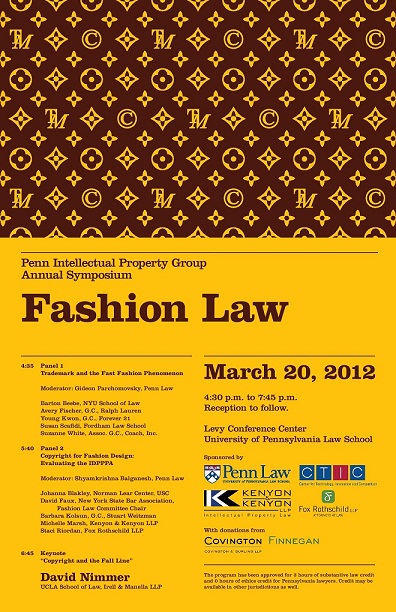
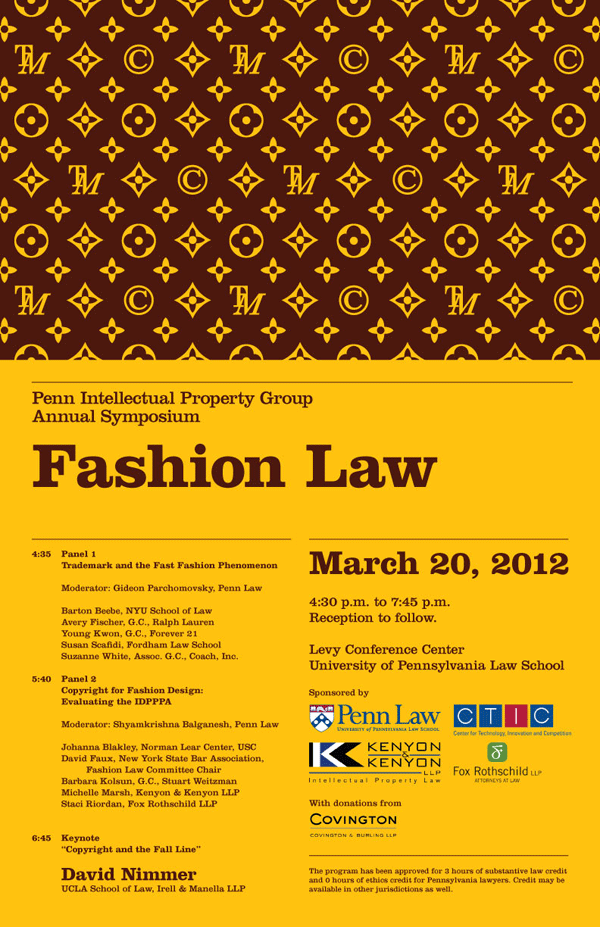
Over the past couple of weeks, the Penn Intellectual Property Group has been the subject of controversy because of a flyer that circulated the law school advertising its much-anticipated Fashion Law symposium by cleverly altering the Louis Vuitton logo.  Before I begin this entry, I would like to note that this blog and its opinions do not represent Penn, Penn Law, or PIPG’s positions on the issues.  I merely seek to comment on the legal aspects of the controversy. On February 29, the Director of North American Civil Enforcement for Louis Vuitton Malletier, Michael Pantalony, sent a cease and desist letter to the University of Pennsylvania Law School’s Dean, Michael Fitts, regarding the Fashion Law symposium flyer.   Mr. Pantalony identified the group’s advertisement as an “egregious action” that is “not only a serious willful infringement and knowingly dilutes the LV Trademarks, but also may mislead others into thinking that this type of unlawful activity is somehow ‘legal’ or constitutes ‘fair use’ because the Penn Intellectual Property Group is sponsoring a seminar on fashion law and ‘must be experts.’” (Letter from Michael Pantalong, Dir. of Civil Enforcement, N. Am., for Louis Vuitton Malletier, to Dean Michael A. Fitts, U. Pa. L. Sch. (Feb. 29, 2012)).

On March 2, Robert Firestone, Associate General Counsel for University of Pennsylvania, fired back the school’s response on behalf of the School and Dean Fitts.  Mr. Firestone’s letter adamently denies infringement and supports PIPG’s flyer as a non-infringing play on the Louis Vuitton label.  The letter argues against infringement claims on two grounds: lack of infringement and lack of dilution.  Mr. Firestone explains that there is no infringement because (1) PIPG’s posters are not being used to identify goods and services; (2) Louis Vuitton’s trademarks are likely not “registered in Class 41 to cover educational symposia in intellectual property law issues;” and (3) there is no likelihood of confusion.  (Letter from Robert F. Firestone, Assoc. Gen. Counsel to U. Pa. L. Sch., to Michael Pantalony, Dir. of Civil Enforcement, N. Am., for Louis Vuitton Malletier (Mar. 2, 2012)).  He supports his denial of lack of dilution by noting that the poster’s artwork is a noncommercial use of the mark and a fair use parody. Id. (“PIPG has not commenced use of the artwork as amark or trade name ...”).

I now consider the validity of one of school’s defenses against Louis Vuitton’s allegations, that being the defense that there is no infringement because there is no likelihood of confusion.  There is no likelihood of confusion here because the PIPG poster is advertising an educational symposium and thus is unlikely to be mistaken for a Louis Vuitton luxury product.  A multi-factor test may be applied to consider all of the factors contributing to likelihood of confusion, which is especially helpful in instances where the allegedly infringing “good” is noncompeting with the trademark’s product.  These factors are:

(1) the degree of similarity between trademark and alleged infringing mark; (2) the strength of the owner’s mark; (3) the price of the goods and other factors indicative of the care and attention expected of consumers when making a purchase; (4) the length of time the defendant has used the mark without evidence of actual confusion arising; (5) the intent of the defendant in adopting the mark; (6) the evidence of actual confusion; (7) whether the goods, though not competing, are marketed through the same channels of trade and advertised through the same media; (8) the extent to which the targets of the parties' sales efforts are the same; (9) the relationship of the goods in the minds of consumers because of the similarity of function; (10) other facts suggesting that the consuming public might expect the prior owner to manufacture a product in the defendant's market, or that he is likely to expand into that market.

A & H Sportswear, Inc. v. Victoria's Secret Stores, Inc., 237 F.3d 198, 211 (3d Cir. 2000) (citing Scott Paper Co. v. Scott’s Liquid Gold, Inc., 589 F.2d 1225, 1229 (3d Cir. 1978)).

On factor (1), Louis Vuitton seems to have a persuasive argument because the marks are similar except Penn Law’s notable TM and © signs.  Factors (2) and (3) relate to the strength and integrity of the parent mark as well as the level of sophistication of a potential buyer of the trademarked good.  As Mr. Pantalony explained, Louis Vuitton’s mark and brand has a long and rich history in which the brand has “built up a worldwide reputation for its design, innovation, quality and style.” (Letter from Michael Pantalong, Dir. of Civil Enforcement, N. Am., for Louis Vuitton Malletier, to Dean Michael A. Fitts, U. Pa. L. Sch. (Feb. 29, 2012).  This effectively means that the mark is likely strong enough to be distinguished from an advertisement that uses a technically different mark and is displayed in a way unrelated to Louis Vuitton’s business.  Additionally, because of the high price point for Louis Vuitton goods, the average consumer would be expected to be familiar enough with the mark to distinguish it from the one displayed on the PIPG poster.

Factor (4) and (6) are not useful here as the Symposium’s poster was only displayed for a matter of days when Louis Vuitton challenged it and there has been no evidence of any actual confusion as to the source of the mark from the advertisement; that is students and legal professionals have understood that the source of the poster is the Penn Intellecutal Property Group and not Louis Vuitton.  The intent of the students in creating the poster was certainly not to infringe or cause confusion regarding the mark, thus putting factor (5) strongly on the University’s side.  Factors (7), (8), (9), and (10) all go to the issue of determining the distance between the markets for the original trademark’s goods and the alleged infringer’s product.  Quite clearly, this is the school’s strongest argument for lack of likelihood of confusion.  Not only is the school not selling a product of any kind, but PIPG was merely spreading information about its educational symposium.  This seems to be a far cry from operating in the marketing channels of an elite luxury good company.  Considering these ten factors altogether, Penn Law School and its IP group have a strong argument against Louis Vuitton’s allegation of likelihood of confusion between the club’s clever advertisement and the corporation’s established brand.

It is important to note, that this is just one of the defenses the school may raise against allegations of trademark infringement.   In the absence of a denial of likelihood of confusion argument, the school seems quite clearly to have a strong defense from liability because “noncommercial use of a mark” is an explicit exclusion in the federal statute on trademark. 17 U.S.C.  § 1125(c)(3)(C) (2006).

Once again, I reiterate this blog merely represents the ideas and opinions of this blogger and do not reflect the opinions of Penn, Penn Law, or Penn IP Group’s on the issue.


Lin-tellectual Property Dispute: The Battle over Trademark Registrations of Jeremy Lin Puns

Jeremy Lin’s Cinderella-story from an undrafted Harvard graduate to NBA sensation has generated a rigorous fan base and “Linnovative” lexicon. However, some fans are looking to not only get caught up in the “Linsanity,” but capitalize on the Lin-spired puns. As of this post, there have been ten trademark registrations for the term “Linsanity.” The United States Patent and Trademark Office (PTO) allows domestic users to register a “word, name, symbol, device, or any combination” used in identifying goods and distinguishing sellers, for a fee of approximately $100. The registration is to be accompanied by a brief description of the distinguished goods or services associated with the mark. If approved, the user receives benefits such as the legal presumption of ownership and exclusive use rights.
Thus far, the ten trademark registrations have ranged from attempting to cover eyeglasses to cell phone covers. A derivative in the form of “Linsanity 17” purports to cover sports drinks and virtual goods. The first to file was Yenchin Chang on February 7, 2012, followed two days later by Lin’s former high school coach Andrew Slayton. The ABA Journal reports the Slayton wanted “to be part of the excitement” and also owns the domain Linsanity.com.

In protection of his intellectual property rights, Lin himself filed a trademark application through an attorney at Arent Fox. Expect to see merchandise such as “Linsanity” duffel bags, mugs, beverages, and even action figures hit the store shelves –all covered by the mark.

While Lin will most likely be successful in registering “Linsanity” because the other applicants lack a legitimate connection to his services, it remains to be seen whether he can keep up with the massive amounts of other puns his sudden fame spawned. Most notably, in the last month there have already been two attempted registrations each for “Linning” and for “Lincredible.”

All trademark applications can be viewed by conducting a basic word search of the appropriate term in the PTO’s Trademark Electronic Search System (TESS), here: http://tess2.uspto.gov/bin/gate.exe?f=tess&state=4009:9l69u7.1.1

Penn Intellectual Property Group Symposium on Fashion Law

Penn Intellectual Property Group is proud to present the Annual Symposium on Fashion Law!  Please join us on March 20, 2012 from 4:30 p.m. to 7:45 p.m. at the University of Pennsylvania Law School. Reception to follow.  


What Penn Intellectual Property Symposium on Fashion Law
Keynote Speaker David Nimmer
Date March 20, 2012
Time 4:30pm to 7:45pm
Location Levy Conference Center, University of Pennsylvania Law School
CLE Approved for 3 hours of substantive CLE Credit
Cost Free for all attendees not applying for CLE Credit;$30 for CLE Credit
RSVP Not required but appreciated.Please RSVP to pipgsymposium@gmail.com